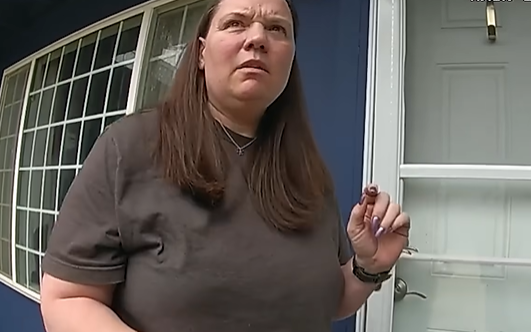
she threw her ticket out the window & sued the officer for "brutality"
It started with something that should have been simple: a traffic stop, a ticket, and a few minutes of interaction between a driver and a police officer.
There was no reason for anyone watching from a distance to expect that the encounter would become a much bigger story.
But then, according to the scenario described by the title, the woman made a decision that changed everything.
She threw her ticket out the window.
And what happened afterward would eventually lead to a completely different kind of confrontation — one involving accusations of police brutality and a legal dispute over what really happened during the encounter.
A SIMPLE TICKET HAD SUDDENLY BECOME THE CENTER OF A MUCH BIGGER STORY.
At the beginning, the officer's task appeared straightforward. The driver had received a citation, and the officer expected the interaction to end once the necessary steps were completed.
But traffic stops can become unpredictable when emotions rise.
A ticket can represent more than a piece of paper to the person receiving it. It can mean an unexpected expense, frustration, inconvenience, or anger. For an officer, however, issuing a citation is part of the job and does not necessarily mean the encounter is personal.
That difference in perspective can create tension.
The officer may see a routine enforcement action.
The driver may see something unfair.
And when those two perceptions collide, a simple conversation can quickly become an argument.
In this case, the moment that reportedly changed the situation came when the woman threw the ticket out of the window.
SHE DIDN'T JUST WALK AWAY FROM THE ENCOUNTER — SHE MADE A VERY PUBLIC STATEMENT.
The paper that represented the citation was suddenly no longer where it was supposed to be.
For the officer, that action could have raised immediate questions.
Was the encounter actually finished?
Was the woman refusing to comply with instructions?
Was the ticket being discarded out of frustration?
Or was there something else happening that the officer needed to address?
From the outside, it may have looked almost absurd.
A small piece of paper.
A short traffic stop.
And suddenly, an argument that would become far more serious.
But that is exactly how some police encounters escalate.
It does not always begin with something dramatic.
Sometimes it begins with disagreement.
A person disagrees with an officer.
The officer gives another instruction.
The person refuses.
The officer repeats it.
The person becomes more frustrated.
And suddenly, the interaction has moved far beyond the original reason for the stop.
THE TICKET WAS NO LONGER THE ONLY ISSUE.
The officer now had to decide how to proceed.
The woman had to decide whether she would cooperate.
And the tension between them continued to build.
If body-camera footage was available, those recordings could become especially important in understanding the encounter. Video can show the sequence of events, the movements of the people involved, and the timing of important exchanges.
But even video may not answer every question by itself.
Context matters.
What happened before the camera began recording?
What instructions were given?
How did each person interpret what was happening?
And when did the encounter move from a disagreement over a citation into a dispute over police conduct?
Those questions would become increasingly important.
Because according to the title, the story did not end with the ticket.
It escalated into an accusation.
SHE LATER SUED THE OFFICER, CLAIMING “BRUTALITY.”
That changes the nature of the story completely.
A traffic stop is one thing.
A lawsuit alleging police brutality is another.
Once an allegation like that is made, the details of the encounter can become the subject of legal scrutiny.
What did the officer do?
What did the woman do?
Was force used?
If so, what led to it?
Was the force necessary under the circumstances?
How did the encounter begin?
And how did it end?
These questions cannot be answered simply by looking at a headline.
They require evidence.
That is why incidents like this often become so controversial.
One person may remember an encounter one way.
The officer may describe it differently.
Witnesses may remember certain moments.
Video may capture others.
And lawyers may later examine every detail.
ONE MOMENT CAN LOOK COMPLETELY DIFFERENT DEPENDING ON WHERE YOU STAND.
For the woman, the experience may have felt like an unnecessary escalation.
For the officer, the same moments may have appeared as an attempt to maintain control of an increasingly difficult situation.
Those are perspectives, not conclusions.
The evidence is what ultimately matters.
But before the legal dispute could even begin, the original encounter had to be reconstructed.
The ticket had been issued.
The woman had reacted.
The ticket had been thrown out of the window.
And then the situation developed into something much larger.
Imagine the tension inside that vehicle.
The driver knows the officer is standing nearby.
The officer knows the interaction has not gone the way expected.
Neither side appears willing to simply forget what happened.
The atmosphere becomes increasingly uncomfortable.
And every new exchange creates another opportunity for misunderstanding.
THE SITUATION WAS NO LONGER ABOUT A PIECE OF PAPER. IT WAS ABOUT CONTROL, COMMUNICATION, AND WHAT HAPPENED NEXT.
This is where traffic stops can become complicated.
Officers are expected to maintain control of an encounter.
Drivers are expected to follow lawful instructions.
But when a driver believes an officer is acting unfairly, emotions can rise quickly.
The challenge is that frustration does not automatically disappear simply because someone is wearing a uniform.
Likewise, an officer's authority does not automatically mean every action will be viewed the same way by everyone involved.
The interaction must still be examined based on what actually happened.
That is why the alleged brutality claim became such an important part of the story.
The woman was no longer simply disputing a ticket.
She was alleging that the officer's conduct crossed a line.
And the officer, depending on the circumstances, would have the opportunity to provide a different account.
THE ARGUMENT OVER THE TICKET HAD BECOME A DISPUTE OVER POLICE CONDUCT.
Once a lawsuit enters the picture, the story becomes even more complicated.
Legal claims involving police officers can require careful examination of constitutional rights, departmental policies, the circumstances surrounding any use of force, and the specific evidence available.
A lawsuit is also an allegation, not automatically proof that the alleged conduct occurred.
That distinction matters.
The fact that someone files a lawsuit does not establish that every allegation in the lawsuit is true.
At the same time, the existence of a lawsuit means the claims may be formally examined through the legal process.
Evidence can be presented.
Arguments can be challenged.
Witnesses can be questioned.
And the details of the encounter can be reviewed.
THE REAL BATTLE WAS NO LONGER HAPPENING ON THE SIDE OF THE ROAD. IT WAS MOVING INTO THE COURTROOM.
The original ticket may have been small enough to fit between two fingers.
But the consequences of the confrontation could become much larger.
Legal fees.
Public attention.
Professional consequences.
Personal stress.
And questions about what actually happened.
All of it could grow from a few minutes during a traffic stop.
That is what makes the story so striking.
The initial issue seemed ordinary.
The ending was anything but ordinary.
The woman apparently believed the officer had crossed a line.
The officer's perspective would have to be considered as well.
And the evidence would have to determine which version of events was supported.
If there was video, it could become one of the most important pieces of evidence.
If there were witnesses, their accounts could matter.
If there were reports or recordings, investigators and attorneys could examine them.
The smallest details could suddenly become important.
A gesture.
A command.
A response.
A movement.
A few seconds of silence.
A sentence that might sound insignificant in the moment could become important later.
WHEN AN ENCOUNTER BECOMES A LAWSUIT, EVERY SECOND CAN BE EXAMINED.
That is why it is dangerous to assume that the most dramatic moment tells the whole story.
The beginning matters.
The middle matters.
The ending matters.
And everything between those moments can change how the encounter is understood.
The woman throwing the ticket out of the window may be the moment that grabs attention.
But it is only one part of the larger sequence.
What happened immediately afterward?
Did the officer attempt to explain the situation?
Did the woman continue to resist instructions?
Did emotions rise?
Did physical contact occur?
Was force used?
And if force was used, what circumstances led to it?
These are the questions that matter when allegations of brutality are raised.
THE HEADLINE CAN BE DRAMATIC. THE EVIDENCE HAS TO BE PRECISE.
For viewers, it can be tempting to choose a side immediately.
One person looks angry.
The other person looks authoritative.
One person makes a complaint.
The other person wears a uniform.
But real incidents are rarely that simple.
A person can be frustrated without being completely right.
An officer can have legal authority without every action automatically being justified.
The only reliable way to understand the incident is to examine the facts available.
That is especially important when legal claims are involved.
The woman's lawsuit would require more than simply saying she felt mistreated.
Her claims would have to be evaluated according to the applicable legal standards and evidence.
The officer could respond with his own account and potentially provide documentation supporting his actions.
And the court or other relevant process would ultimately determine what claims could be established.
A LAWSUIT IS A PROCESS OF TESTING CLAIMS — NOT AN AUTOMATIC VERDICT.
That distinction often gets lost when dramatic police footage becomes public.
People see a short clip.
They hear a powerful headline.
They form an opinion.
But a few seconds of footage may not show everything that happened before the recording.
It may not show what each person knew.
It may not explain why an officer made a particular decision.
And it may not establish the legal conclusions that later become part of a lawsuit.
That is why the full context matters.
In this case, the image of a woman throwing her ticket out of the window is memorable.
It is unusual.
It is confrontational.
And it immediately raises questions.
Why did she do it?
Was she angry?
Did she believe the ticket was unfair?
Did she think throwing it away would end the conversation?
Or did the action itself become the beginning of an even bigger dispute?
ONE PIECE OF PAPER BECAME THE SYMBOL OF A MUCH LARGER CONFLICT.
The officer, meanwhile, was faced with a decision.
Ignore the action and move on?
Continue the interaction?
Give another instruction?
Escalate enforcement?
Every option could have consequences.
Police officers often have to make decisions without knowing what will happen next.
But those decisions can later be reviewed with the benefit of hindsight.
That is one of the difficult realities of police work.
An officer makes a decision in seconds.
Later, that decision may be examined for hours, days, or months.
People can pause video.
Replay audio.
Read reports.
Analyze movements.
Ask what could have happened differently.
The person making the original decision did not have that luxury.
THE CAMERA CAN BE PAUSED. REAL LIFE CANNOT.
Still, that does not mean officers are beyond scrutiny.
When a citizen alleges misconduct, those claims can and should be examined through appropriate processes.
The same principle applies to allegations against the citizen.
If a person is accused of resisting, obstructing, or otherwise violating the law, those allegations also require evidence.
The goal should be to determine what actually happened, not simply which side tells the more dramatic story.
And that is where this incident becomes particularly interesting.
It contains all the elements that can turn a minor traffic encounter into a major dispute.
A citation.
A disagreement.
A dramatic gesture.
A confrontation.
An allegation of brutality.
And finally, a lawsuit.
THE ORIGINAL TRAFFIC STOP MAY HAVE LASTED MINUTES. THE DISPUTE COULD LAST FAR LONGER.
For the woman, filing a lawsuit may have been a way to challenge what she believed was unacceptable conduct.
For the officer, defending against the lawsuit could become a matter of explaining and justifying the actions taken during the encounter.
For the public, the incident becomes another example of why police interactions can generate intense disagreement.
But the public does not get to decide the facts simply by watching the most dramatic moment.
Evidence does.
That evidence could include recordings, reports, witness statements, physical evidence, and court filings.
The legal system exists in part to examine those competing claims.
And that process can reveal details that are not obvious from a short clip.
Maybe the incident was exactly what the headline suggests.
Maybe the context changes how the events appear.
Maybe both sides had important details that were not initially visible.
Without the complete evidence, certainty is difficult.
THE MOST IMPORTANT PART OF THE STORY MAY BE WHAT THE CAMERA DIDN'T SHOW.
That is why the phrase “brutality” carries significant weight.
It is not simply another word for an unpleasant interaction.
When used as a legal or factual allegation, it can refer to specific conduct that must be evaluated under applicable standards.
The accusation deserves attention.
But the accusation alone is not proof.
Likewise, the officer's position deserves consideration.
But the officer's position alone is not proof either.
The evidence must connect the two.
This is where a dramatic story becomes a serious investigation.
The emotions are easy to understand.
The facts are harder.
And facts require patience.
The encounter begins with a ticket.
The woman throws it away.
The officer responds.
The interaction escalates.
Then comes the allegation.
Then the lawsuit.
And eventually, the legal process must determine what can actually be established.
WHAT LOOKED LIKE A SMALL ARGUMENT ON THE SIDE OF THE ROAD HAD BECOME A QUESTION OF RIGHTS, RESPONSIBILITY, AND EVIDENCE.
The story also highlights how quickly public perception can change.
At first, someone may see the woman as simply angry about receiving a ticket.
Then they hear that she sued the officer.
Suddenly, they may wonder whether the officer did something wrong.
But then another version of the story appears.
And another question emerges.
What happened in between?
That middle section is often where the truth lives.
Not in the headline.
Not in the accusation.
Not in the reaction.
But in the sequence of events connecting them.
The exact order matters.
Who moved first?
Who gave which instruction?
Who responded?
What happened next?
Those details can completely change the meaning of an encounter.
CONTEXT CAN TURN A SHOCKING MOMENT INTO A VERY DIFFERENT STORY.
That is why incidents like this should be viewed carefully.
The woman throwing the ticket may be the most memorable image.
The allegation of brutality may be the most provocative phrase.
The lawsuit may be the most consequential development.
But none of those elements alone tells the entire story.
Together, they create a narrative that demands closer examination.
And that examination is what investigators, attorneys, courts, and sometimes independent reviewers are tasked with doing.
For the public, the lesson is equally important.
A police stop can seem insignificant until something goes wrong.
A ticket can seem like nothing more than an inconvenience until an argument develops around it.
A disagreement can become a confrontation.
And a confrontation can create consequences far beyond the original traffic violation.
A FEW MINUTES CAN CREATE MONTHS OR YEARS OF CONSEQUENCES.
That is why both citizens and officers have reasons to keep encounters as calm and controlled as possible.
For citizens, following lawful instructions and using established procedures to challenge a citation can help prevent unnecessary escalation.
For officers, clear communication and measured responses can help reduce confusion and create a better record of what happened.
Neither side controls everything.
But both sides can influence how an encounter develops.
In the incident described by this title, however, the crucial moment had already occurred.
The ticket had been thrown away.
The relationship between the driver and officer had changed.
And the interaction had become something neither side could simply erase.
Once the lawsuit was filed, the argument moved into a different arena.
THE SIDE OF THE ROAD WAS REPLACED BY THE COURTROOM.
There, the emotional intensity of the original encounter would have to be translated into evidence.
Words would become statements.
Actions would become exhibits.
Footage would become evidence.
And allegations would become claims that could be challenged.
The process could be slower than the original encounter, but that is exactly the point.
A court does not operate at the speed of a traffic stop.
It has time to review.
Time to question.
Time to compare.
Time to examine.
And time to determine which claims are supported.
For viewers who encounter the story through a dramatic headline, that distinction is important.
The title tells us what makes the story unusual.
It does not necessarily tell us everything that happened.
THE HEADLINE STARTS THE STORY. THE EVIDENCE FINISHES IT.
In the end, the most fascinating part of this incident may not be the ticket itself.
It may be the chain reaction that followed.
A citation became a disagreement.
The disagreement became a confrontation.
The confrontation became an allegation.
And the allegation became a lawsuit.
Each step moved the story farther away from the simple traffic violation that started it all.
That is how quickly an ordinary encounter can become extraordinary.
And it is also why people should be careful when judging events based on a single dramatic moment.
There may be more to the story.
There may be competing accounts.
There may be evidence that supports some claims and contradicts others.
And there may be important details that never appear in the most widely shared version of the incident.
THE TRUTH IS OFTEN FOUND BETWEEN THE FIRST COMMAND AND THE FINAL CONSEQUENCE.
For the woman, throwing the ticket out of the window may have felt like an expression of frustration.
For the officer, it may have been interpreted differently.
For observers, it became a memorable moment.
And for the legal system, it became only one piece of a much larger dispute.
The story ultimately reminds us that police encounters are not just about what happens in a few seconds.
They are about what led to those seconds.
They are about how each person reacted.
And they are about what happened afterward.
Because once an accusation is made, the question is no longer simply, “Who was angry?”
The question becomes, “What actually happened?”
That is a much harder question.
And it requires much more than a headline.
ONE TICKET. ONE DECISION. ONE ESCALATING ENCOUNTER. AND ONE LAWSUIT THAT CHANGED THE ENTIRE STORY.
What began as a routine traffic matter became an incident involving competing accounts, allegations of brutality, and legal scrutiny.
The woman believed she had grounds to challenge the officer's conduct.
The officer would have an opportunity to explain his actions.
And the evidence would become central to determining how the encounter should be understood.
The ticket itself was eventually no longer the most important thing.
The bigger question was how two people reached the point where a simple traffic stop became a legal battle.
That question is what makes the story so compelling.
Because sometimes the most dramatic police encounters do not begin with a dangerous suspect or a high-speed chase.
Sometimes they begin with a small piece of paper.
A citation.
A disagreement.
A decision to throw it away.
And then, unexpectedly, everything changes.
WHAT STARTED WITH A TICKET ENDED WITH A LAWSUIT — AND THE REAL STORY WAS EVERYTHING THAT HAPPENED IN BETWEEN.
WATCH FULL
Comments (0)
Loading comments...
May You Like
Attorney’s Vacation Takes a Bad Turn During Traffic Stop
Police video shows suspect shooting Milwaukee police officer, stealing his squad car
Multi-Car Freeway Wreck
Latest Posts


Popular Posts
A Criminal Arrest as Dramatic as an Action Movie
Sep 26, 2026